
You Sell Life-Saving Technology. Can You Actually Save a Life on the Side of the Road?
Why Every Medical Device Sales Rep (actually everyone) Should Keep an Emergency Kit in Their Car

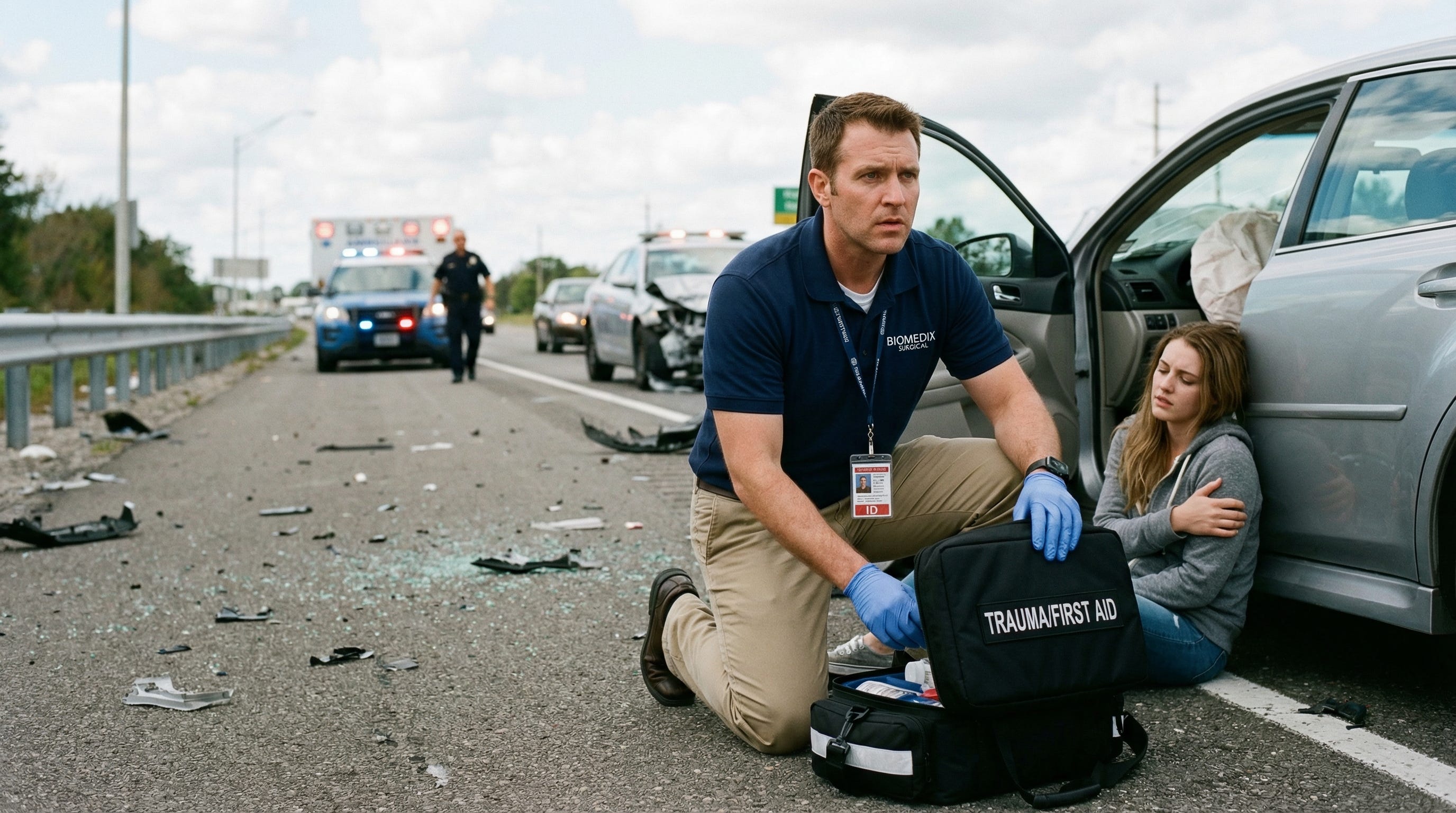
It’s 5:43 a.m. on a Tuesday. You’re heading to your first case of the day — coffee in hand, your favorite podcast playing — when traffic on the interstate slows to a crawl. Ahead, two cars have collided. One is on its side. You pull over. You approach. There’s a person bleeding heavily from their arm, conscious but in shock. EMS has been called. They’re seven minutes away.
Seven minutes is a long time when someone is bleeding out.
You look back at your car. Besides your trays, trunk stock and some product literature, you have nothing. Not a tourniquet. Not a pressure bandage. Not even a pair of gloves.
That scenario plays out on American roads every single day. The question is: when it happens near you, will you be ready?
The Scale of the Problem
The numbers are sobering. According to the National Highway Traffic Safety Administration (NHTSA), approximately 39,345 people died in traffic crashes in 2024. Millions more were seriously injured. The National Safety Council estimates 5.1 million medically consulted injuries from motor vehicle incidents in 2023 alone — that’s roughly 14,000 people hurt on American roads every single day.
Here’s the statistic that should stop you cold: the CDC has found that of the 1.5 million annual crashes where 911 dispatched EMS, 40% of victims were still alive when first responders arrived — but later died from their injuries. The ambulance got there in time. The window before it arrived did not.
You Are on the Road More Than Almost Anyone
Think about your average week. You drive to hospitals, surgery centers, clinics, and offices across your territory — sometimes covering hundreds of miles in a single day. Industry data suggests field sales reps commonly log between 25,000 and 40,000 miles per year, and medical device reps are among the most road-intensive professionals in any industry.
That kind of mileage doesn’t just mean more wear on your tires. It means you are statistically more likely than the average person to drive past, or arrive at, the scene of an accident. Not once in a career — regularly. You are, by the nature of your job, a frequent presence on the roads where emergencies happen. The question isn’t really if you’ll encounter an accident. It’s whether you’ll have anything useful when you do.
What Bystanders Can Actually Do — And How Much It Matters
You don’t need to be a paramedic to save a life. Research is clear that ordinary people acting in the minutes before EMS arrives can dramatically change outcomes.
On bleeding: Uncontrolled hemorrhage is the single biggest cause of preventable death in trauma, responsible for up to 40% of trauma fatalities — and 33–56% of those deaths occur before EMS arrives. A study published in Prehospital Emergency Care found that applying a tourniquet before reaching a trauma center is associated with a 4.5-fold decrease in mortality. Another analysis estimated that up to 57% of civilian deaths from hemorrhage could have been prevented with adequate hemorrhage control. The tools to do that are simple, inexpensive, and small enough to fit in a bag in your trunk.
On cardiac arrest: The American Heart Association reports that bystander CPR, when performed immediately, can double or triple a victim’s chance of survival. A landmark 2024 study found that people who received CPR within two minutes had an 81% greater chance of surviving compared to those who received no bystander CPR at all. Survival chances decrease by roughly 10% for every minute CPR is delayed.
The bottleneck isn’t knowledge alone — it’s having the right tools on hand at the right moment.
What to Keep in Your Car
You don’t need a full trauma bay in your trunk. You need a compact, well-organized kit that gives you options. Here’s what emergency medicine professionals and organizations like the Red Cross, NHTSA, and AAA recommend:
For trauma and bleeding:
CAT Tourniquet — the military and civilian standard for stopping severe limb bleeding; designed to be applied with one hand
Hemostatic gauze (like QuikClot) — for wounds where a tourniquet can’t be used
Israeli pressure bandage — highly absorbent compression bandage for wound control
Nitrile gloves — protect yourself while helping others
Trauma shears — to cut away clothing and expose wounds quickly
For cardiac emergencies:
CPR face shield or mask — makes rescue breathing safer and more effective
Pocket guide or reference card — for high-stress moments when you need a reminder
For scene safety:
Reflective triangles or LED road flares — to protect you and the victim from oncoming traffic
Flashlight or headlamp — for nighttime accidents
Emergency mylar blanket — prevents hypothermia, an often-overlooked cause of trauma death
Seatbelt cutter and window breaker — AAA specifically recommends keeping this within arm’s reach of the driver’s seat
Pre-assembled bleeding control kits (sometimes called IFAKs or Stop the Bleed kits) are widely available online for $50–$150 and contain most of what you need in a single, organized bag. Pair it with a Stop the Bleed course — a free or low-cost class offered nationwide that teaches tourniquet application and basic hemorrhage control in under two hours.
The Right Place at the Right Time
People in medical device sales spend their careers getting life-saving technology into operating rooms. Every day, the work you do means patients get better care. But those outcomes happen in hospitals, with teams, and with time to prepare.
Roadside emergencies don’t work that way. They’re sudden, chaotic, and decided in minutes. The only thing that determines whether a bystander can help is whether they happen to be nearby — and whether they have what they need.
You’re already nearby. More than almost anyone else on the road, you are there. The only missing piece is a bag in your trunk.
That’s a very fixable problem.
Sources
National Highway Traffic Safety Administration (NHTSA). Early Estimates of Motor Vehicle Traffic Fatalities in 2024. https://www.nhtsa.gov/press-releases/nhtsa-2023-traffic-fatalities-2024-estimates
National Safety Council. Motor Vehicle – Introduction – Injury Facts, 2023. https://injuryfacts.nsc.org/motor-vehicle/overview/introduction/
Allen Law Group, citing CDC data. Helping Hurt Car Crash Victims Before EMS Arrives.
https://www.kenallenlaw.com/
Faul, M., Aikman, S.N., Sasser, S.M. Bystander Intervention Prior to the Arrival of Emergency Medical Services. CDC/Prehospital Emergency Care, 2016. https://stacks.cdc.gov/view/cdc/40331
PMC/Stop the Bleed framework study. A Framework for the Design and Implementation of Stop the Bleed Programs. https://pmc.ncbi.nlm.nih.gov/articles/PMC9611563/
Stop the Bleed Training study. “Stop the Bleed” Training Empowers Learners to Act. ScienceDirect, 2018. https://www.sciencedirect.com/science/article/abs/pii/S0002961018305257
Efficacy of publicly accessible tourniquets. Systematic Review of Layperson Performance. PMC, 2025. https://pmc.ncbi.nlm.nih.gov/articles/PMC12625582/
American Heart Association. CPR Facts and Stats. https://cpr.heart.org/en/resources/cpr-facts-and-stats/
American Heart Association News. Starting Bystander CPR Within 10 Minutes May Improve Survival, 2024. https://www.heart.org/en/news/2024/11/11/starting-bystander-cpr-within-10-minutes-of-cardiac-arrest-may-improve-survival
American Red Cross. Emergency Car Kit: What to Include. https://www.redcross.org/take-a-class/resources/articles/car-emergency-kit-what-to-include
True Rescue. Car First Aid Kit Checklist – 14 Must-Haves. https://truerescue.com/blogs/knowledge/car-first-aid-kit-checklist